
- Home
- About Us
-
Product Range
- Liquid Bottling Machine
- Filling Machine
- Automatic Capping Machine
- Sticker Labelling Machine
- Liquid pouch filling machine
- Powder Bottle Filling Machine
- Powder Pouch Filling Machine
- Conveyors
- Enquiry
- Contact Us

By admin 17 Aug 2026
When it comes to oil manufacturing firms, increased production capacity is not only about making more bottles but is also about having precise filling rates, less downtime, minimizing any wastage and ensuring that everything flows smoothly on the production line. In times of increased demand, it becomes hard to manage the process manually or through semi- automatic methods.
This is where an Automatic Oil Filling Machine makes all the difference. With automation of one of the critical processes in the packing of oil, faster and more efficient packing can be achieved while reducing reliance on manual labour.
For businesses that want to increase production but maintain the quality of their packaging materials, automation is one way to help accomplish this objective.
The filling stage will significantly impact the speed at which the bottles can proceed to capping, labeling, and packaging. If filling is slow or inconsistent, it can create a bottleneck that affects the entire packaging line.
Filling manually involves having workers measure the amount of oil to be dispensed per bottle. This may be appropriate for small manufacturers, but ensuring the efficiency of the process becomes difficult as volume increases.
An automated system is designed to handle repetitive filling tasks with greater consistency, helping manufacturers maintain a predictable production rhythm.
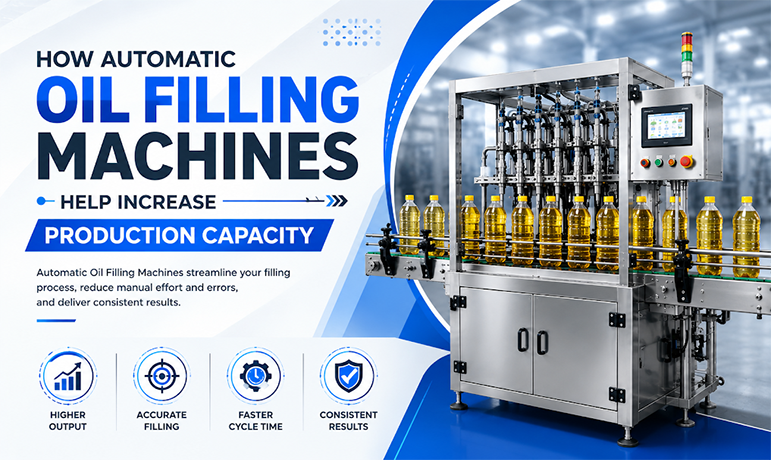
One of the most obvious advantages of an Automatic Oil Filling Machine is its ability to fill multiple containers efficiently.
Instead of depending entirely on individual operators, the machine performs the filling operation according to predefined settings. Depending on the machine configuration and production requirements, multiple filling heads can work simultaneously.
This means that a larger number of bottles can be processed in a certain period of time, thus assisting companies to increase production levels without necessarily increasing labor force.
Production capacity is not only about maximum speed. Consistency matters just as much. In case the filling rate is not consistent during a manufacturing shift, there is a possibility that the bottles will not be delivered to the packaging equipment consistently.
An automatic filling system can maintain a more consistent operating cycle. Once the machine is correctly configured, each filling cycle follows the programmed process, supporting smoother movement of containers through the production line.
Manual filling involves repetitive activities such as positioning bottles, operating filling controls, monitoring quantities, and moving filled containers.
As production volume increases, these tasks can place additional demands on workers and increase the possibility of human error.
Automation reduces the amount of repetitive work required from operators. Employees can instead focus on machine monitoring, quality checks, material management, and other important production activities.
This makes better use of available manpower while allowing the filling operation to continue at a controlled pace.
Oil is a valuable product, so even small amounts of unnecessary filling can become significant when thousands of bottles are processed.
Overfilling not only increases product consumption but can also affect packaging consistency. Spillage around containers or filling nozzles can create additional product loss and cleaning requirements.
It is designed to deliver controlled quantities according to the required filling specifications. Better filling control can help manufacturers reduce unnecessary product giveaway and improve overall material utilization.
A filling machine rarely works alone. In a modern packaging line, filling may be followed by capping, sealing, labeling, coding, and packing.
If the filling stage operates at an inconsistent speed, it can affect the performance of the equipment that follows it.
An automated filling system can help establish a more predictable flow of filled containers. When properly integrated with conveyors and downstream machines, this can contribute to a smoother overall packaging process.
Increasing production capacity depends on selecting a machine that matches the actual requirements of the business.
Choosing a machine based only on maximum filling speed may not always provide the best result. Overall line compatibility, reliability, filling accuracy, and flexibility should also be evaluated.
For manufacturers planning to automate or upgrade their oil packaging operations, choosing the right equipment partner is an important decision.
Nextgen Packaging Solution provides packaging machinery designed to support efficient and consistent industrial packaging operations. Understanding the product, container, required output, and overall line configuration helps ensure that the selected Automatic Oil Filling Machine is suitable for the intended application.
A well-planned filling solution can help manufacturers improve productivity while maintaining better control over filling operations.
Increasing production capacity does not always mean expanding the workforce or adding more production space. Improving the efficiency of existing packaging processes can provide a more practical solution.
The use of an Automatic Oil Filling Machine enables manufacturers to accelerate the filling process, achieve consistency in the production cycle, minimize manual interventions, control product wastages, and synchronize with other packaging machines.
As oil packaging requirements continue to grow, automation can help businesses build a more reliable and scalable production process. With the right machine configuration and proper integration, manufacturers can increase output while maintaining the filling consistency and operational control needed for long-term growth.
For businesses planning to improve their oil packaging capacity, investing in the right automation technology can be an important step toward building a faster, more efficient, and more dependable production line.