
- Home
- About Us
-
Product Range
- Liquid Bottling Machine
- Filling Machine
- Automatic Capping Machine
- Sticker Labelling Machine
- Liquid pouch filling machine
- Powder Bottle Filling Machine
- Powder Pouch Filling Machine
- Conveyors
- Enquiry
- Contact Us

By admin 22 July 2026
A plant supervisor at a beverage unit once told me something that stuck: "We don't lose customers over what's in the bottle. We lose them before they even open it." Harsh, maybe, but not wrong. A crooked label, an air bubble trapped under the sticker, a slightly off-centre print — customers register all this in about two seconds flat, usually without even realizing they're doing it.
That's really where the whole conversation around automatic labelling machines starts. Not from a technical angle, but from a shelf angle.
Beverage manufacturing is a strange mix of speed and fragility. Bottles move fast on the conveyor, but liquids are messy — condensation, spills, humidity, temperature swings. Manual labelling holds up fine when you're running small batches. Push volumes up, though, and workers get tired by hour three, labels start drifting, and suddenly your "premium juice brand" looks like it was packed in someone's garage. Not because the product is bad. Because the label wasn't straight.
This is usually the point where beverage brands go looking for a proper Automatic Bottle Sticker Labelling Machine manufacturer , instead of trying to squeeze more output from manual labour that's already stretched thin.
So what actually changes with automation? A few things, honestly.
Sensors and motor-driven controls place the label in the exact same spot every time — bottle 10, bottle 10,000, doesn't matter. Nobody standing at a supermarket shelf thinks "wow, perfectly aligned label." But they absolutely notice a wonky one. It's one of those things that only gets attention when it's gone wrong.
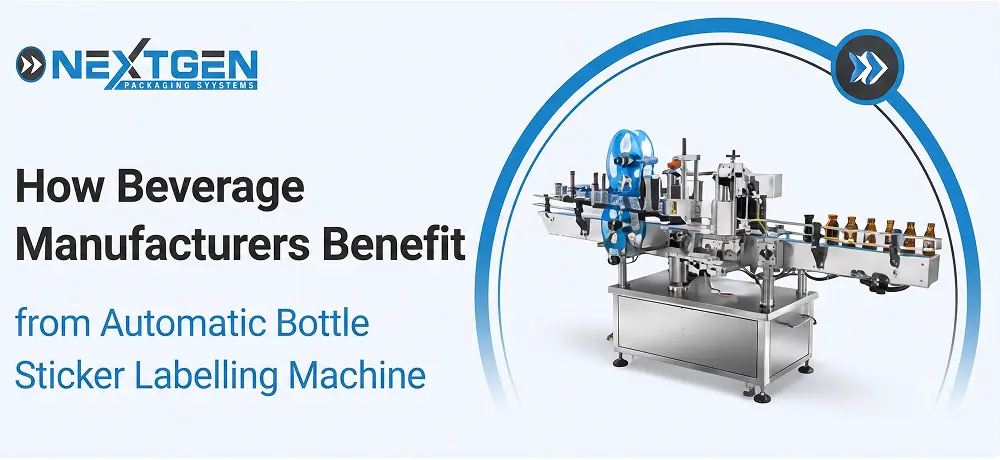
Filling and capping stations on a beverage line don't slow down for anyone. If labelling can't keep pace, it becomes the one station holding everything else up — bottles piling up, workers scrambling, production targets slipping. A well-built automatic labelling unit is meant to run in sync with high-speed conveyors, so the whole line moves as one unit rather than in fits and starts.
This one gets overlooked a lot. Beverage floors are rarely dry. There's condensation on chilled bottles, regular washdowns, humidity that never fully clears. A machine built in S.S. 304 stainless steel handles that kind of environment without rusting out or seizing up after a few months. Mild steel components just don't last in this setting, no matter how good the machine looks on day one.
There's also the money side of it, which honestly matters more to most plant owners than anything else on this list. Every crooked or torn label is wasted material. Multiply that across a full shift, then a month, then a year, and it adds up fast. Features like vibration-free label roll units and built-in product counters aren't flashy, but they quietly cut that waste down, batch after batch.
None of this shows up as some dramatic before-and-after. It's more like a slow, steady improvement — fewer rejects, tighter batches, a label that looks the same on bottle one as it does on bottle five thousand.
Labelling might seem like a small piece of the packaging puzzle, but for beverage brands, it's often the first thing a customer actually judges. Getting it right, consistently, at speed, in a wet and demanding production environment, isn't something generic machinery handles well. Nextgen Packaging Solution builds automatic sticker labelling machines specifically suited to this kind of high-speed, moisture-heavy beverage production. If you're evaluating an Automatic Bottle Sticker Labelling Machine manufacturer for your bottling line, you can check out the full machine range at nextgenpackagingmachinery.com