- Home
- About Us
-
Product Range
- Liquid Bottling Machine
- Filling Machine
- Automatic Capping Machine
- Sticker Labelling Machine
- Liquid pouch filling machine
- Powder Bottle Filling Machine
- Powder Pouch Filling Machine
- Conveyors
- Enquiry
- Contact Us

By admin 28 Sept 2026
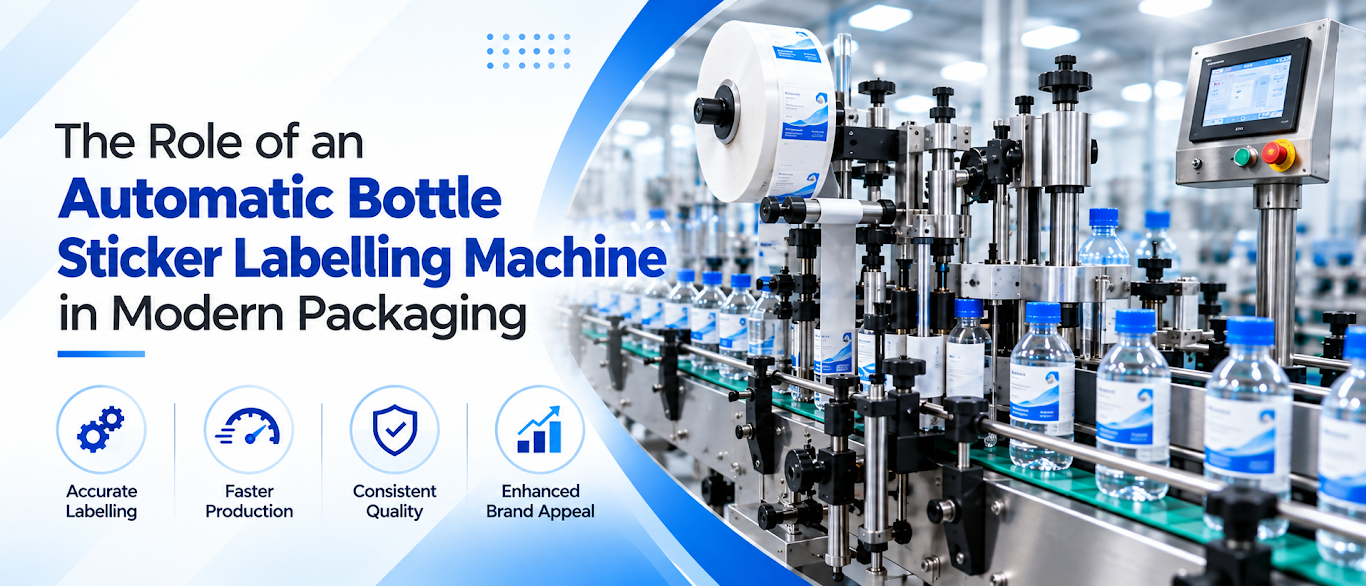
In modern manufacturing, packaging is no longer limited to protecting a product. It also plays an important role in branding, product identification, customer information, and production efficiency. Among the different stages of packaging, bottle labelling needs to be accurate, consistent, and fast. This is where an Automatic Bottle Sticker Labelling Machine becomes an important part of a modern packaging line.
An automatic labelling system can apply self-adhesive stickers to bottles and containers with consistent positioning while reducing the amount of manual work required. Nextgen Packaging Solution provides automatic labelling solutions designed for different bottle shapes, label sizes, and industrial applications.
However, when the quantity of production increases, labeling by hand becomes time consuming and is not always consistent. Problems that occur include misalignment, creasing, air pockets, label waste, and inconsistencies between bottles.
An automated system helps standardize this process. Sensors sense the bottle, the labelling system releases the necessary sticker, and the label gets applied to the preset position. Based on the machine setup, automatic labelling machines can deal with bottles that are round, flat, oval, or of any other shape.
For manufacturers looking for higher productivity and consistent packaging quality, automation can therefore become an important part of their production strategy.
The basic operation involves several coordinated stages. Bottles are transported through the machine using a conveyor system. A sensor detects the incoming container and communicates with the control system. The label dispensing unit then releases the sticker at the appropriate time.
The bottle and label move together so that the sticker is positioned accurately on the container. Rollers or other application mechanisms help press the label against the bottle surface.
Modern-day machinery can be controlled with PLC controls, HMI touch screens, servo or stepper motor controllers, and photoelectric sensors. All these are essential for controlling and regulating the labelling process based on the manufacturing needs.
1. Consistent Label Placement
One of the biggest advantages of automated labelling is consistency. Every bottle can receive its label in a similar position, helping create a uniform appearance across the finished batch.
2. Better Production Efficiency
Automation reduces repetitive manual labelling work and supports continuous production. Depending on the model, bottle labelling machines can operate at different production speeds to match the requirements of the packaging line. Nextgen's listed automatic systems include configurations ranging from around 40 BPM to higher-output models.
3. Reduced Label Wastage
Accurate dispensing and application can help minimize incorrectly applied labels. This can be especially useful when labels are customized, expensive, or contain important product information.
4. Flexible Bottle Handling
Modern automatic labelling equipment can be configured for different container shapes and materials. Applications can include PET, HDPE, glass, plastic, and other commonly used packaging containers.
5. Easy Integration With Packaging Lines
The automatic labeling machine can be integrated into a larger packaging line that includes fillers, cappers, and conveyors. This allows manufacturers to create a more streamlined production process.
Automatic bottle sticker labelling systems are widely useful across industries where bottles and containers require professional product identification.
In the pharmaceutical industry, the labels may include the name of the product, batches, expiry date, barcodes, and many more. Thus, consistency becomes very crucial here.
In the case of food and beverage industries, the labels may include branding, list of ingredients, nutritional value, or any other details about the product.
Another industry which requires well designed labels includes the cosmetics and personal care industry, which comprises shampoo, lotion, creams, oils, etc.
Chemical, agrochemical, lubricant, and FMCG manufacturers can also benefit from automated labelling solutions for different bottle and container formats.
Selecting a labelling machine should begin with the actual packaging requirements. Manufacturers should consider bottle shape, bottle dimensions, label size, label material, required production speed, number of labels, and available floor space.
It is also important to consider the machine's construction and control system. For example, Nextgen's automatic labelling equipment includes SS304 construction, PLC-based controls, sensors, and adjustable labelling systems in various configurations.
The right machine should provide reliable operation while allowing practical adjustments when bottle or label specifications change.
A fully automatic bottle labelling machine has been an integral part of modern packaging automation. With accuracy in labeling, proper functioning, flexibility in handling bottles, and greater efficiency in production, such a machine can contribute in achieving consistency in packaging.
For companies planning to automate or upgrade their labelling process, choosing NextGen Packaging Solution, a reliable Automatic Bottle Sticker Labelling Machine Manufacturer is an important step toward building a dependable and efficient packaging line.