
- Home
- About Us
-
Product Range
- Liquid Bottling Machine
- Filling Machine
- Automatic Capping Machine
- Sticker Labelling Machine
- Liquid pouch filling machine
- Powder Bottle Filling Machine
- Powder Pouch Filling Machine
- Conveyors
- Enquiry
- Contact Us

By admin 7 Aug 2026
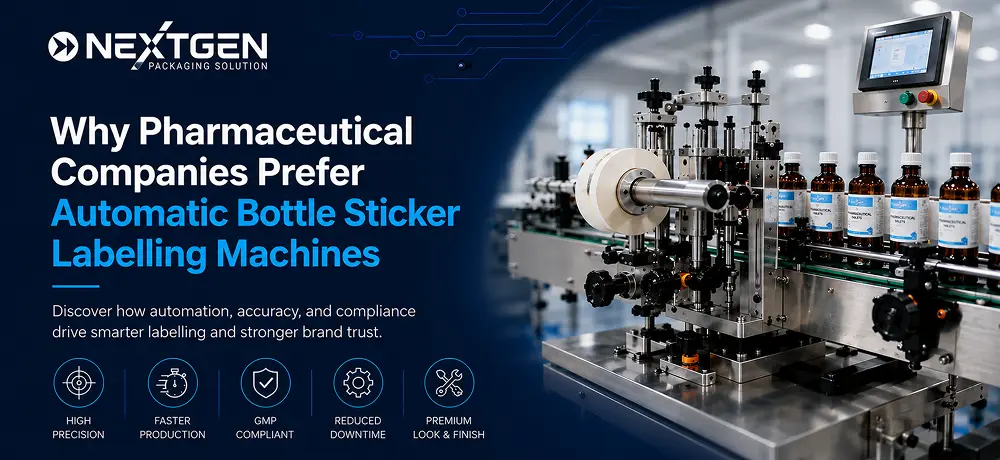
Walk into any pharma packaging line today and you'll notice something - almost nobody is applying labels by hand anymore. That's not an accident. Labelling in pharma isn't decorative. It's the one step that keeps a patient from taking the wrong dose, or a regulator from shutting down an entire batch.
A misaligned label on a bottle of shampoo may be irritating to the customer. Misalignment of a label on a bottle of insulin could actually land the person in a hospital. Drugs have batch numbers, expiry date details, dosage requirements, and barcode labels which need to be scanned by the pharmacist. If any of these is misaligned, smeared or missing, then it becomes a serious issue.
Manual labelling has a failure rate even with a careful, well-trained team. People get tired by hour six of a shift. Labels go on crooked. Someone grabs the wrong roll without noticing. A machine doesn't get tired, and it won't grab the wrong roll unless someone loaded it wrong to begin with.
Pharma companies usually aren't labelling a few hundred bottles a day - they're running tens of thousands through one line. An experienced worker is capable of handling 15 to 20 bottles manually per minute. This is an excellent performance in terms of manual labor. However, an average Automatic Label Machine handles 60 to 150 bottles per minute.
This may seem like a small figure until it is seen being applied in a manufacturing process. For example, if the filling machines have a capacity of 100 bottles per minute while the labelling machine can only do 20, then the latter will become the bottleneck. Automating that one station removes the ceiling.
The FDA, WHO-GMP, and other drug authorities don't just check that a label exists. They check placement, print clarity, and whether the right label ended up on the right product. Machines apply labels at the same position, same pressure, same angle, run after run. That kind of repeatability is hard to promise with hand application no matter how good the operator is - people just aren't that consistent, even the best ones.
Some machines also come with barcode verification and vision inspection built in, so a bottle with a wrong or missing label gets pulled off the line automatically. Manual lines don't have that safety net at all.
Contamination control is its own headache in pharma manufacturing. Every extra person near an open bottle is another contamination risk, plus another person who needs gowning, training, and hygiene sign-off. Cutting down on direct human contact at the labelling stage helps on the cleanliness side and quietly helps the labour bill too.
When pharma companies shop for equipment, they're not only comparing speed. They ask whether the manufacturer understands validation paperwork, whether the machine handles round, oval, and flat bottles without a full changeover, and whether spare parts show up fast if something breaks mid-shift - because something always breaks eventually.
Cost comes into it too. Most companies that make the switch from manual to automatic labelling say the machine pays for itself in a year or two, mostly through less rework and fewer recalls rather than through any dramatic labour savings.
With the ever increasing production of pharmaceuticals, there is a need for packaging machinery that is fast, accurate, and reliable. The Automatic Bottle Sticker Labelling Machine helps in reducing manual errors, increase efficiency in production, adhere to regulations, and ensure quality packaging.
For pharmaceutical companies seeking dependable automation, partnering with an experienced Automatic Bottle Sticker Labelling Machine manufacturer, like NextGen Packaging Solutions is a smart investment. The correct machine ensures not only greater operational efficiency but also protection of the product from degradation, building up of the brand's reputation, and future business success.